


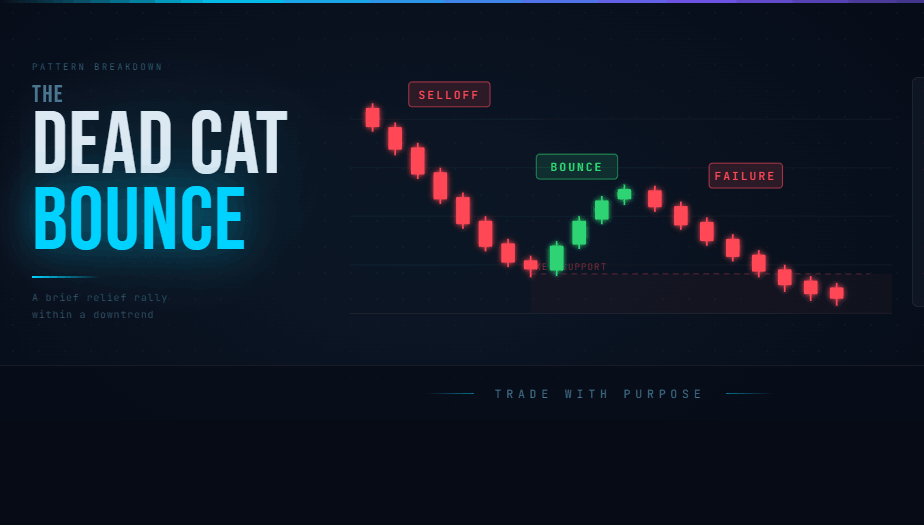
One of the fastest ways to hand money back to the market is to mistake a dead cat bounce for a real reversal, and most traders do it at least once before the lesson sticks.
The setup repeats every year. A stock gets crushed, the financial media starts using the word "value," and a wave of traders online declare that the bottom is in. The stock rallies for a few days, sometimes a couple of weeks, and the money that sat out the decline rushes back in trying to make up for it. Then the stock rolls over and prints new lows underneath everyone who bought the relief.
That relief has a name. The dead cat bounce.
What a dead cat bounce actually is
A dead cat bounce is a temporary rally inside a larger decline. The bounce feels like the worst is over, the downtrend resumes anyway, and the name comes from the old trading-desk line that even a dead cat will bounce if it falls far enough. The bounce is real. The reversal is not. The trend underneath it never changed.
The sequence tends to run the same way. A stock drops hard. Buyers step in convinced it is oversold. Short sellers ring the register and cover. Price rallies on that buying. Resistance holds where it held before, sellers take control again, and the stock makes a new low. Most of the people who get hurt buy somewhere in the middle of that rally and stay long while it gives the gains back.
Why the bounce happens
Short covering does a lot of the early work. When a name falls fast, the traders who are short lock in profit, and their buying pushes price up regardless of whether anything has improved. Layer in oversold technical readings that pull in dip buyers, and the move builds on itself for a session or two.
The rest is human. Nobody wants to admit they missed the bottom, so fear flips to optimism before the chart has earned it, and a single headline (an analyst upgrade, a soft-positive earnings comment, a macro print) gives that optimism a reason to act. None of those things require the trend to have turned. They just require people to believe it has.
Reading a bounce for what it is
At Coinfish we trade trend, momentum, and probability, and we let the chart talk before the headlines do. A few things tell us a rally is more likely a dead cat than a turn.
Price still living below the major moving averages is the first one. If a name is sitting under its 55 EMA or 200 EMA, the longer-term trend has not done anything to repair itself. Real reversals reclaim those levels and start holding above them, and until that happens the burden of proof is on the bulls.
Volume tells the next part. Strong reversals show up with rising participation, so when a bounce runs on lighter volume than the selloff that preceded it, the buyers behind it are thin. MACD that stays pinned below the zero line says the same thing in a different language, that momentum is still working against the stock even while price ticks up.
Then there is structure. A name can rally a long way and remain in a clean downtrend, and as long as the bounce fails to clear the prior swing high, you are looking at a lower high inside the same pattern that has been in force the whole time. The last check is the simplest one. If the business, the earnings outlook, and the conditions around the company have not changed, the only thing that moved is the price, and a cheaper version of a broken story is still a broken story.
A stock printing a green candle does not mean the trend has changed. The traders who lose the most are usually the ones who confused a bounce with a reversal and sized up on the difference.
How we trade around it
Plenty of traders go hunting for the exact bottom. We would rather stack the odds and take the middle of a move we can actually see.
We do not sell bull put spreads on a name just because it looks cheap, because cheap is not support and a stock down fifty percent can fall another fifty from there. We also do not buy the first bounce off a major breakdown on faith. The market does not owe anyone a reversal, and trading like it does is how accounts bleed.
Before we put on a bullish position we want evidence that buyers are back in control:
- Price reclaiming the 21 EMA and then the 55.
- A bullish MACD crossover and a positive Elder Force Index.
- Higher highs paired with higher lows.
- Volume that confirms the move, and a squeeze firing in the direction of the trend.
No single one of those makes a trade. The more of them that line up at once, the higher the probability we are stepping into something real instead of a trap.
Where credit spreads fit
Bull put spreads are one of our core plays because they define the risk up front and pay us for time passing. Context decides whether the spread is a trade or a donation.
Consider the bad version. A stock drops thirty percent, rallies five the next day, and nothing underneath it has changed. A lot of traders sell a put spread right under that bounce and call it income. They are selling against support that has not been proven, and when the stock rolls over the spread goes against them fast.
Now the patient version. The same stock declines, then stops going down and consolidates. The 21 EMA crosses up. MACD turns positive. Volume improves and price carves out a higher low that holds on a retest. A bull put spread placed below that established low is a different trade entirely, with the short strike sitting under a floor the market has actually defended. Same strategy, same underlying, completely different risk because we waited for the chart to give us a level instead of guessing at one.
What about debit spreads
A bounce with real momentum behind it can also set up a bull call debit spread, where the risk is fixed and known the moment you enter. We still want confirmation first. A bounce without trend confirmation is a guess, and a bounce with improving momentum and repaired structure is a setup. We trade the second one.
The Coinfish rule
We are not trying to buy the low tick. We are trying to participate in the high-probability middle of a move, where the evidence has stacked up and the trade can be managed with defined risk. Catching bottoms makes for a good story at the bar. Compounding a defined-risk process is what actually grows an account.
So the work stays the same. Defined risk on every position. Setups that earn their place. Patience while the chart proves itself. Capital protected first, returns second. Wait for confirmation. Protect the capital. Let probability carry the weight, and be honest with yourself about which one you are actually looking at.