


Every trader knows the feeling of a position that was green on Tuesday and is bleeding by Friday. You told yourself you would manage it. Now you are sitting there negotiating, one more day, theta will pull it back, the stock always bounces here. That conversation is the most expensive one in trading, and the only thing that ends it cleanly is a rule you set before you ever clicked the order.
This is about that rule. Where it comes from, how to size it, how to read your screen so you know when it is hit, and the part nobody likes to talk about, which is having the discipline to honor a line you drew when your account was not on it.
Risk and reward come first, not last
You decide the terms of a trade before you enter, not while you are in it. On a defined-risk credit spread that means knowing four numbers cold: the credit you collect, the width of the strikes, your max profit, and your max loss. The spread already caps the downside for you, which is the whole reason we trade them. But a capped loss and a loss you are willing to take are two different things.
A defined-risk spread tells you the worst the market can do. A stop tells you the worst you will let it do.
Here is the trap in that gap. On a five-wide spread where you collect 0.55, your max loss is 4.45. The market can take the full 445 dollars per contract. Almost nobody actually wants to lose the whole width on a single trade, and if you did, you would be handing back eight or nine winners to pay for one. So the real question is not what the position can lose. It is what you have decided to lose before you move on. That decision is your stop.
The 1x and the 2x
There are two clean ways credit sellers set that line, and they are worth understanding as separate choices instead of one fuzzy idea.
- The 1x stop. You close when the position value has doubled against you. Collect 100 dollars in credit, and you exit when it would cost 200 to buy the spread back. Your realized loss at that point is one times the credit, 100 dollars. Tighter leash, more trades stopped out, smaller damage on each.
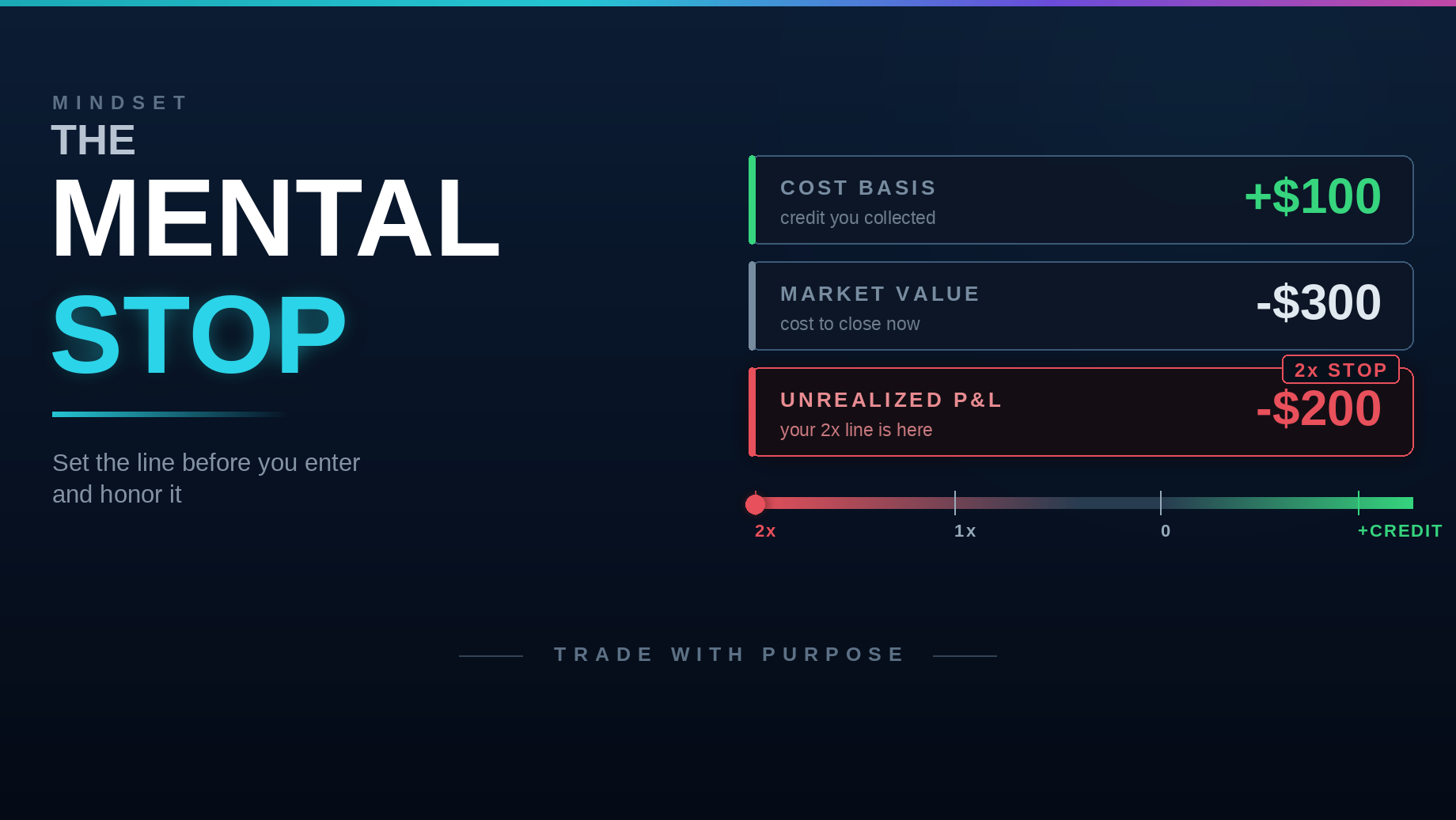
- The 2x stop. You close when your actual loss reaches two times the credit. Collect 100, and you exit when you are down 200, which is the spread costing 300 to close. Wider leash, fewer whipsaw exits, bigger give-back when it does fail.
I run the 2x. The reason is the time frame. I am holding an average of ten to fifteen days, trading off the higher time frame, and a tighter stop gets chopped up by noise that has nothing to do with whether the trade is working. Give a position that kind of runway and normal daily movement stops meaning something. A 1x stop on a two-week hold would have me closing trades that were never actually in trouble.
One guardrail on this. Two times the credit only works as a stop if it is smaller than the spread's max loss. On that 0.55 credit, five-wide example, a 2x loss is around 110 dollars and the width caps you at 445, so the stop fires well before the cap and does its job. On a narrow spread with a fat credit, check that 2x is actually inside the width first, or the structure caps you before your rule ever triggers.
Reading the screen: market value against unrealized P&L
To run any of this you have to read two columns correctly, because they are not the same thing and traders mix them up constantly.
Your cost basis is the credit you took in. Your market value is what it would cost to close the position right now. Your unrealized P&L is the difference between them, and that is your actual open profit or loss.
The stop lives on the P&L number. When your unrealized loss hits your 1x or 2x line, you are out. Simple.
What confuses people is that a credit spread is almost always red the instant it fills. That is not the trade going against you. It is the bid and ask spread. You got filled near the mid, and the platform immediately marks you at what it costs to cross the spread and close, so you start down by roughly the width of that market. Nothing is wrong. You just cannot open and instantly close for free.
Some of your opening red is the spread, not the trade. Learn to tell them apart, because only one of them is a reason to do anything.
This is worth internalizing because it changes what you react to. On tight index names the opening red is small. On a wider single name it can look alarming and be almost entirely the spread. If the red sits there and slowly improves as time passes, that is the trade working. If it keeps deepening while price walks toward your short strike, that is the trade failing, and those are two completely different situations that can look identical if you are only watching the dollar figure.
Where the chart comes in
The stop is mechanical. The reading around it is not, and that is the part that takes reps.
The P&L number tells you how much you are down. The chart tells you why, and whether it is likely to get worse. For a credit spread the levels that matter are your short strike and your breakeven, plus the delta on that short strike, which is quietly telling you the odds of it going in the money. When price is drifting toward the short strike and that delta is climbing, the trade is getting more dangerous even if your stop has not been touched yet. That is your window to make a good early decision, roll the tested side, take a partial, or just close for a smaller loss than the rule would eventually force.
Watching the daily move and where price sits relative to those strikes is the discretionary part of this. It is real skill and it is worth developing. But keep it anchored to those specific levels. General chart-staring turns into noise and noise turns into second-guessing.
Why mine lives in my head
I use a mental stop, not a resting stop order, and that is a deliberate choice for how I trade. Hard stops on spreads can get triggered by a bad mark or a thin, ugly quote in the first minutes of the session, filling you at a terrible price on a position that was fine. On a higher time frame hold I would rather check the trade against my rule once a day, with real quotes, and make the call myself.
That freedom comes with a cost, and the cost is honesty. A mental stop is only as good as your willingness to act on it. A resting order does not care how you feel. A mental one asks you to be disciplined at the exact moment discipline is hardest, when you are in the trade, down money, and every story your brain is telling you is a reason to wait.
A mental stop is a real stop that happens to depend entirely on your integrity.
So I make it concrete. The number goes in the trade log at entry, before the position can do anything to me. I know my 2x line the moment I put the trade on. Then it is just a matter of checking it and doing what I already decided.
The part that actually decides it
You can understand every number in this post and still blow it, because the hard part was never the math. The hard part is the moment the line gets hit.
That is when the mind gets creative. Sunk cost tells you that you have already waited this long. Hope tells you theta is about to do its work. Ego tells you closing here means you were wrong. None of those are analysis. They are the reasons a planned loss turns into an unplanned one, and they show up precisely when the position is in trouble, which is the one time they can do real damage.
The whole point of setting the rule beforehand is that you make the decision while you are calm and let it carry you through the moment you are not. Following it is not a nice-to-have layered on top of the strategy. It is the strategy. A trader with a mediocre setup and the discipline to cut losers at a fixed line will beat a trader with a great setup who negotiates every stop, every time, over a long enough run.
Taking the 2x loss on purpose, on a trade that broke your level, is not a failure. It is the process working exactly as designed. The account is not built by the trades you refuse to lose. It is built by losing the small, planned amount so you are still standing, and still sized correctly, for the winners that pay for all of them.
Set the line before you enter. Read your screen well enough to know when it is hit. Then follow the rule, especially the day you least want to.