


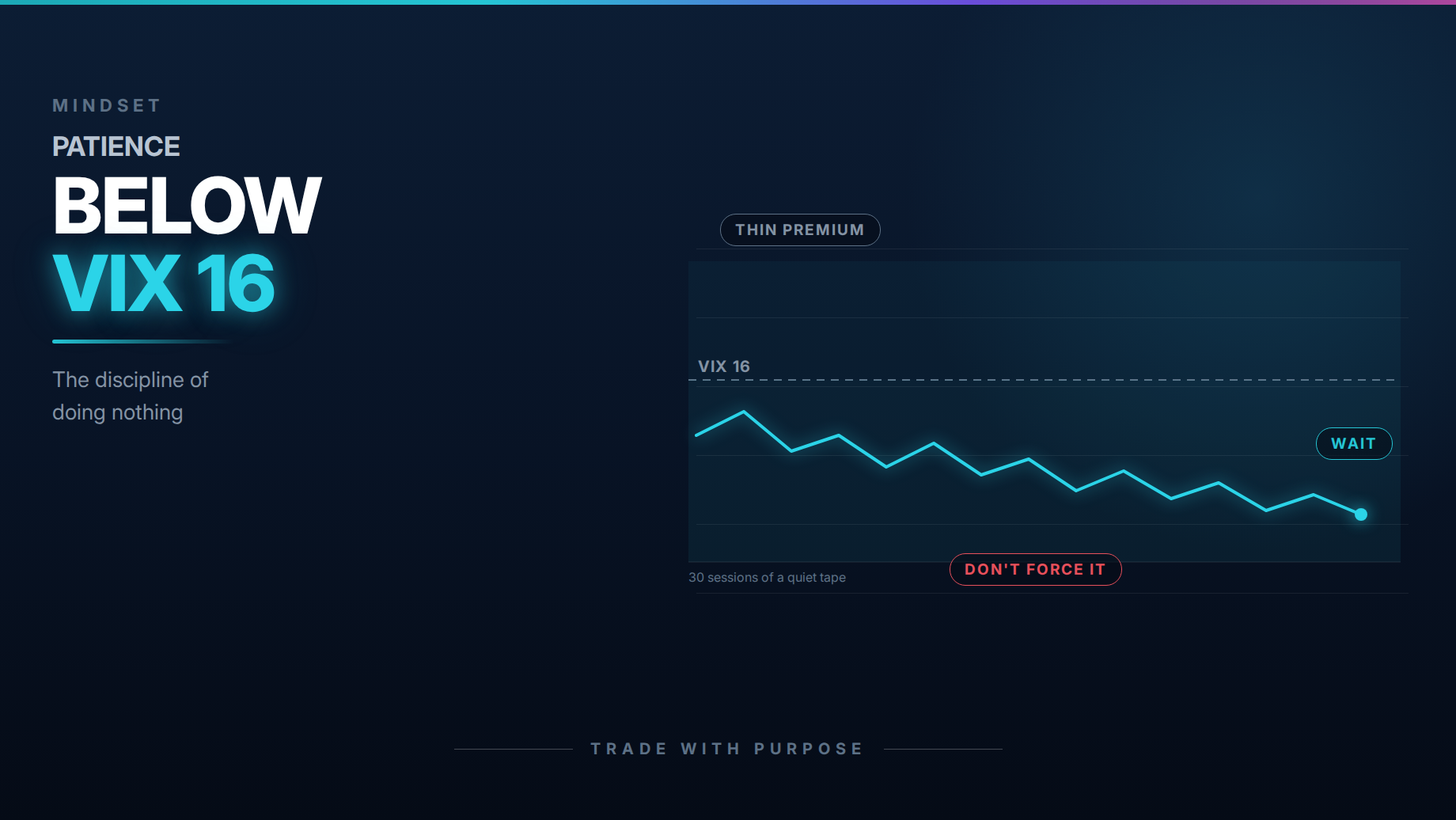
There is a specific kind of restless that shows up when VIX sits in the 13s and 14s and the account has not taken a new position in a week. Nothing is wrong. The screen is just quiet, and quiet feels like falling behind even when the math says otherwise. That is the mood I want to talk about, because it has cost me more than any single bad trade ever has.
The strategy is not complicated. Sell premium, bull put spreads mostly, on SPY, QQQ, IWM. Collect a credit for taking a defined risk and let time do the rest. It works because probability is on my side when I sell it right. But probability only shows up over a run of trades, and a run of trades takes weeks I do not always feel like sitting through, especially when the number that is supposed to tell me to wait is sitting right there on the screen refusing to move.
Why below 16 is the hard environment
This is not a feeling, it is arithmetic. Standard strike selection sells around 0.20 to 0.25 delta, and the credit at that delta scales with implied volatility. When VIX drops under 16, that credit gets thin. You are still taking on the full width of the spread as your max loss, but the reward side of the ratio has shrunk, and the risk/reward on the trade you would normally place gets marginal fast.
The honest response to that is not to force the same trade anyway. It is to change the trade: move closer to ATM and accept a lower probability of profit for a credit worth collecting, narrow the wings, stick to the index names where there is still enough liquidity to make it worth doing, and carry two or three positions instead of five or six. Some weeks the honest response is fewer trades, not smaller ones. That is not a workaround. That is the plan working as designed for the environment it is in.
A quiet VIX is not a broken market. It is a market telling you the edge on this particular trade got smaller, and asking whether you are willing to hear that.
What the itch actually feels like
Here is the part that does not show up on a strike-selection cheat sheet. Two open positions instead of six does not feel like discipline while you are living inside it. It feels like doing nothing, and doing nothing while the scanner keeps lighting up with names breaking out of a squeeze is one of the more uncomfortable places a trader can sit.
I know this one from the inside. This summer, with VIX camped under 16 and premium too thin to make the setups I usually run worth placing, I watched the squeeze scanner flag a couple of names breaking out and I bought calls on them instead of waiting. Not spreads. Long calls, outright, on a directional bet that had nothing to do with the strategy that actually built the account.
Why that trade was worse than a bad spread
A losing bull put spread is a known number. I sized it, I capped it, and the worst case was on the table before I clicked send. A long call on a squeeze play carries none of that. You need direction, magnitude, and timing all at once, theta is working against you instead of for you every single day the move does not show up, and there is no defined edge behind the entry the way there is when you are the one selling probability instead of buying it. I was not trading my strategy. I was trading my discomfort with sitting still, and I dressed it up as opportunity because the setup looked clean on a chart.
Neither trade was a blowup. That is almost the more useful part of the story. If they had wrecked the account, the lesson would have been obvious and I would not need to write about it. Instead they were small, forgettable trades that quietly proved a point I already knew and had decided, for a week, not to act on: the account grows from the process I actually built, not from the process I switch to when the first one gets boring.
Trusting the strategy when it asks you to wait
The playbook already answers the question of what to do under VIX 16. Fewer positions. Strikes closer to ATM. Narrower width. Indexes only. It is a real plan, not an absence of one, and following it produces a specific kind of week: less action, smaller size, and a P&L line that mostly does not move. That week is not a failure of the strategy. It is the strategy pricing the environment correctly and telling you to size accordingly.
- The rule is not "don't trade below 16." It is trade less, closer in, and only where there is still enough premium to justify the risk.
- A quiet account is not an idle account. Watching the setups, tracking VIX, waiting for the number to move back into the 16 to 25 range where the standard playbook runs clean, that is active work even when no ticket gets sent.
- The itch to do something is not information about the market. It is information about you, and the two should never get treated as the same signal.
The actual lesson
Selling premium works because I am getting paid to be patient in a way the market can price and respect. Buying a call on a squeeze setup because the account has been quiet for a week is paying to feel busy. Those are opposite trades wearing similar-looking charts, and the only thing that tells them apart is whether you built an edge into the position or borrowed one from a feeling.
The market does not care that two weeks of a 14 handle on VIX feels like standing still. It will move again. Premium will come back. The strategy was never broken during the wait, and neither was I, and the version of this trade that actually compounds an account is the one where you let the quiet week be quiet and trust that the setups you are not taking are exactly the ones the rule was built to keep you out of.